The World’s Best Hiking Destinations: A Global Trekker’s Guide
From the Tour du Mont Blanc to the Inca Trail, Kilimanjaro and the Atlas Mountains, a global guide to the world’s best hiking destinations — what makes each one special, how hard it is, when to go, and how Morocco’s High Atlas ranks among them.
Why a global view makes you a better trekker
Every serious trekker eventually builds a mental list of the world’s great hiking destinations. Comparing them is not about ranking one mountain above another — it is about understanding what each offers, how hard it is, and when to go, so you can match a destination to your fitness, your time and the kind of experience you want. This guide walks through the world’s best hiking destinations and then places Morocco’s Atlas Mountains among them, because the High Atlas deserves a place on any global trekker’s list.
We have trekked, guided and compared routes across continents. What follows is an honest, experience-led overview of the destinations that genuinely earn their reputation, with difficulty, season and the kind of trekker each suits.
The world’s best hiking destinations at a glance
| Destination | Country / region | Difficulty | Best season |
|---|---|---|---|
| Tour du Mont Blanc | France, Italy, Switzerland | Moderate | Jun–Sep |
| Inca Trail to Machu Picchu | Peru | Moderate | May–Sep |
| Mount Kilimanjaro | Tanzania | Hard | Jan–Mar, Jun–Oct |
| Everest Base Camp | Nepal | Hard | Mar–May, Sep–Nov |
| Torres del Paine W Trek | Chilean Patagonia | Moderate | Nov–Mar |
| Annapurna Circuit | Nepal | Moderate–Hard | Mar–May, Oct–Nov |
| West Highland Way | Scotland | Easy–Moderate | Apr–Oct |
| Atlas Mountains & Mount Toubkal | Morocco | Moderate–Hard | May–Oct |
Tour du Mont Blanc — the classic Alpine circuit
The Tour du Mont Blanc is the benchmark multi-day hut-to-hut trek in Europe: roughly 170 km circling the Mont Blanc massif through France, Italy and Switzerland over 8–11 days. It is moderate rather than technical — long days with significant ascent and descent, but on well-marked trails — and its refuges, food and logistics are the most developed of any trek in the world. It suits fit walkers who want Alpine drama without mountaineering, and it books up months ahead in summer.
The Inca Trail to Machu Picchu — history at altitude
The classic 4-day Inca Trail combines high Andean passes (Dead Woman’s Pass, 4,215 m), cloud forest and the unforgettable sunrise arrival at Machu Picchu through the Sun Gate. Permits are strictly limited and sell out months ahead. It is moderate in technical terms but the altitude is a real factor — acclimatising in Cusco first is essential. The reward is a trek where every step is layered with archaeology.
Mount Kilimanjaro — the highest trekable summit in Africa
At 5,895 m, Uhuru Peak on Kilimanjaro is the highest point in Africa and one of the Seven Summits, reachable without technical climbing on several walking routes (Machame, Lemosho and the Northern Circuit are the most scenic). The challenge is almost entirely altitude — a slow, multi-day ascent is the key to success. It suits trekkers who want a serious high-altitude objective and can dedicate 7–9 days.
Everest Base Camp — the Himalayan pilgrimage
The trek to Everest Base Camp (5,364 m) is the world’s most famous high-altitude walk: roughly 12 days through Sherpa villages, Buddhist monasteries and increasingly dramatic Himalayan scenery to the foot of the Khumbu Icefall. It is hard — long days, sustained altitude and the need for careful acclimatisation — but non-technical, and the cultural depth of the Sherpa homeland is as memorable as the mountains.
Torres del Paine W Trek — Patagonia in miniature
The W Trek in Chilean Patagonia is the most accessible way to experience the granite spires, glaciers and turquoise lakes of Torres del Paine National Park, a UNESCO biosphere reserve. Over 4–5 days it links the three valleys that give the trek its “W” shape. It is moderate, but Patagonian weather is famously fierce — wind, rain and even snow can arrive in summer — so good gear and flexibility matter.
Annapurna Circuit and the West Highland Way
Nepal’s Annapurna Circuit is the great alternative to Everest: a 2–3 week traverse from subtropical valleys to the high Thorong La pass (5,416 m), offering extraordinary cultural and ecological variety. For something gentler, Scotland’s West Highland Way is the classic first long-distance trail — 154 km from Milngavie to Fort William, easy to moderate, with village accommodation throughout and a genuine lowland-to-highland journey.
The Atlas Mountains and Mount Toubkal — Morocco’s global contender
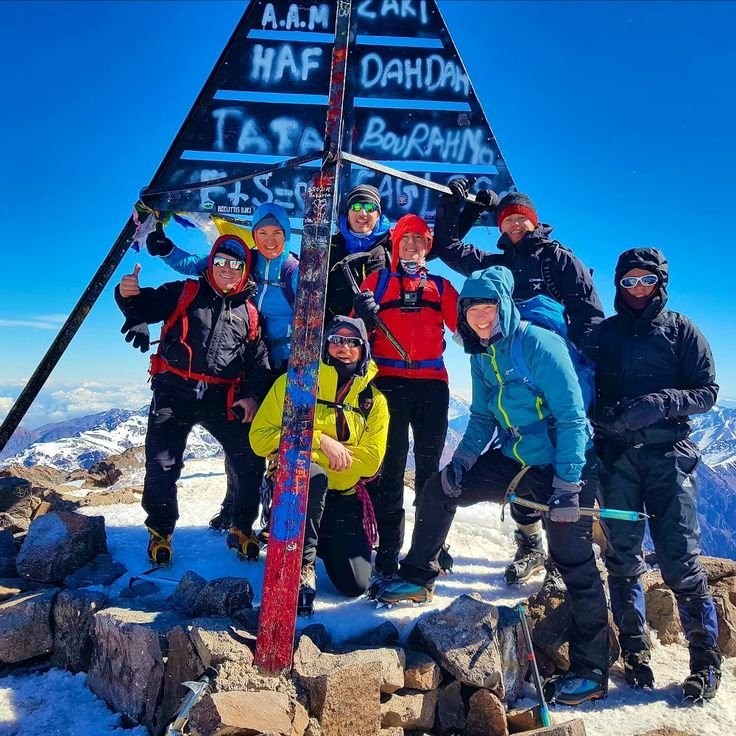
This is where Morocco earns its place on the global list. The High Atlas offers North Africa’s highest summit, Mount Toubkal (4,167 m), reached on a 2- or 3-day trek from Marrakech that is non-technical in summer — a genuine 4,000 m summit accessible to fit hillwalkers without mountaineering skills. Beyond the summit, the Azzaden–Toubkal circuit, the M’Goun traverse and the village-to-village routes of Aït Bougmez deliver the same ingredients that define the world’s best destinations: dramatic scenery, deep local culture and genuine solitude.
What sets the Atlas apart globally is accessibility and value. The main trailheads sit within 60–90 minutes of Marrakech, so you spend your days walking rather than driving; a 2-day Toubkal summit trek starts from €319 per person all-inclusive; and every trek is led by a local Berber guide with mule support and village guesthouse stays. Few global destinations combine a 4,000 m summit, living Amazigh culture and that level of affordability.
2-day Mount Toubkal trek 3-day Mount Toubkal trek with acclimatisation Azzaden–Toubkal circuit (4 days) Hiking in Morocco — the complete guide
How to choose your next hiking destination
- For a first multi-day trek: the West Highland Way, the Tour du Mont Blanc, or Morocco’s 3-day Toubkal — all moderate, well-supported and non-technical.
- For a high-altitude summit without climbing: Toubkal (4,167 m) or Kilimanjaro (5,895 m) — both walk-up routes where pacing and acclimatisation are the challenge.
- For culture as much as scenery: the Inca Trail, Everest Base Camp, or Morocco’s Berber village treks through Azzaden and Aït Bougmez.
- For solitude: the Annapurna Circuit, M’Goun traverse, or the Anti-Atlas around Siroua and Saghro.
- For accessibility and value from Europe: Morocco’s Atlas Mountains — short transfers, affordable all-inclusive treks, year-round options.
Frequently asked questions
What is the best hiking destination in the world?
There is no single answer — it depends on what you want. The Tour du Mont Blanc is the benchmark Alpine circuit, the Inca Trail pairs trekking with archaeology, Kilimanjaro and Toubkal offer walk-up 4,000–5,000 m summits, and Everest Base Camp is the great Himalayan pilgrimage. Morocco’s Atlas Mountains rank among the best for accessibility, value and culture.
Which is the easiest world-class trek for beginners?
Scotland’s West Highland Way and the Tour du Mont Blanc are the most accessible long-distance treks. In Morocco, the 3-day Toubkal trek and the Imlil Valley day hike are excellent first mountain experiences — moderate, well-supported and non-technical.
How does Mount Toubkal compare to Kilimanjaro?
Both are non-technical walk-up summits where altitude is the main challenge. Kilimanjaro is far higher (5,895 m vs 4,167 m) and takes 7–9 days; Toubkal is reached in 2–3 days from Marrakech, is far more affordable, and needs less time off work. Toubkal is one of the few 4,000 m summits on earth reachable in a weekend.
Do I need a guide for the world’s best treks?
For most, yes — either because permits require it (Inca Trail), because altitude and safety demand it (Kilimanjaro, Everest Base Camp, Toubkal), or because trails are unmarked and there is no mountain rescue (the Atlas). A local guide also unlocks the culture and language that make a trek memorable.
When is the best time to trek the Atlas Mountains?
May to October for the High Atlas high trails (snow-free), with May and September the best overall months. October to April for the desert and Anti-Atlas. Winter Toubkal ascents are possible with crampons and a winter guide. See our seasonal guide for detail.
How much does trekking the Atlas Mountains cost compared to other destinations?
The Atlas is one of the most affordable world-class trekking destinations. Day hikes start at €85 per person (transfer and lunch included) and the 2-day Toubkal summit trek from €319 all-inclusive — a fraction of the cost of equivalent Alpine or Himalayan trips.
Related tours
- Toubkal 2 Day Trek — Guided Climb of North Africa's Highest Peak
- Toubkal 3 Day Trek — Guided Climb with Acclimatization
- Toubkal Circuit Trek — Azzaden Valley to Mount Toubkal Summit
- Mgoun Massif Traverse — 6 Days